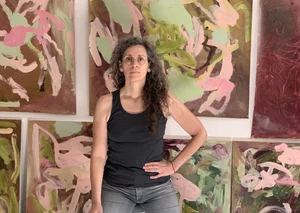
On March 4 during a 2-hour discussion/debate I successfully defended (with minor revisions) my dissertation AutoAbstraction: An Autotheoretical Analysis of a Postfeminist Painters Praxis. My examiners, Professor Andrew Renton, Goldsmith College, London University, London and Peter Appleton, Reader, Liverpool John Moores University were both rigorous with their questions and critique, and also really generous with their time and praise. They requested I make minor revisions to the exegesis, which I will make before resubmitting for their approval. I'm humbled by the process and grateful for the results.
Peter Appleton added a note:
This is an interesting attempt to situate a personal painting practice within historical and theoretical discourses. It explores how the practice of painting, in particular through the coinage of ‘Autoabstraction’, offers spaces for the making of art as well as proposing a correctives to received histories of painting: “Painting is at once a metaphysical path and also a critical space.”
The viva was productive and Dominique defended her research and approaches well.
There was some productive discussion during the viva as to the location of the illustrations of Dominique’s own paintings, as these are central to the PhD’s research period, and represent the major part of its outcomes. There seemed to be consensus that they could be moved to form their own chapter, separate from the comparative pairings.
In art historical terms, the thesis is concerned with the ‘the 21st-century re-gendering of abstraction’s origins’, through Hilma af Klint, in particular. Dominique’s framing provides a space for her own practice to mark itself as the continuation of this ‘tradition’ as well as providing a continuous, internal critique.
We have some concerns with how this is articulated. The reclaiming of Hilma af Klint as a pioneering abstract artist is a relatively recent phenomenon. Dominique takes for granted that art history has been recalibrated to situate af Klint as an abstract artist. Who did this? It needs to be referenced. The question, for me, would be whether af Klint would define herself in these terms, or whether we are indeed looking back at her practice and co-opting her as a dynamic force in the established definitions of abstraction. That is, are we still bound to the definitions of abstraction by artists and historians who spoke in such terms? Did af Klint think or speak of her practice in this way? It would be useful to read more regarding her perspective, if available. Similarly, in establishing a queer space for af Klint, for example? We wonder if her voice might be heard in some way?
By the same token, this instability of definition is managed in very practical ways by Dominique. Her methodology of pairing her own paintings with historic precedents is fascinating and varied. There is a cumulative effect which emerges persuasively from these generated affinities, although there were some concerns that there were too many examples. With re-organisation, the pairings could remain complete. Of course, questions emerge in relation to the process. Although extensively articulated, we would like to learn more about the processes. Does the painting come before the association or vice versa? This series of paintings give the impression that they are made in series very swiftly, but the thought process which accompanies them, seems to unfold over a much longer period. (Dating seems to confirm this.) Dominique gave forceful explanations of these processes during the viva.
We have some concerns with the way Dominique constructs her personal narrative. We very much value the honest self-interrogation that much of the writing displays. There are strong, original moments, particularly in relation to abstraction and ethnicity, for example. I think this personalised articulation is very hard to do, and the text makes a useful contribution to how practice based research might be presented. However, there are many moments where the articulation often includes too much of the ‘learning’ process. Some examples:
an essay I first read in the 1990s while studying 97
I have long taught and loved Willem de Kooning’s work and am especially enamored of
his Pink Angels. 107
the known-to-me idea that WWII…plus the new-to-me 107
I have seen Vir Heroicus Sublimis many times at MoMA and taught it to countless numbers of art history and painting students.
It is among the thousands of paintings I have been awe-struck by during my career. It’s one
of countless that stays with me. 109
As a teenager, I studied 114
I did not yet make the connection between it and my praxis painting 115
He suggested I look at it so, I did. And, I’ve been a fan of it since. 124
he did not intend for me to take as a compliment, but I did. 125
Ackermann’s work, which I was only peripherally aware of prior to my thesis research, 127
After reading I noted 138
It’s fair to say that Newman’s painting, at the time he painted
it, is still controversial.
There are many similar examples, which mark Dominique’s coming into understanding. This is not to say that these transformations should not be marked somehow, and indeed, the subjectivity of this journey is an important part of this research. However, it might be useful to revisit the text and address some of these ‘confessional’ moments. Conventional scholarship would expect the learning process to be already mediated and working towards resolution. This is a different approach to research and should not be dismissed as such, but we think there might be more economy applied to these moments of (self-)discovery.
These suggestions are considered minor amendments and will strengthen the thesis. The suggested re ordering of the chapters with the main body of illustrations forming its own chapter asserts the value of this body of work as an articulated enquiry in its own right.